

July 19, 2026 • 2 hours
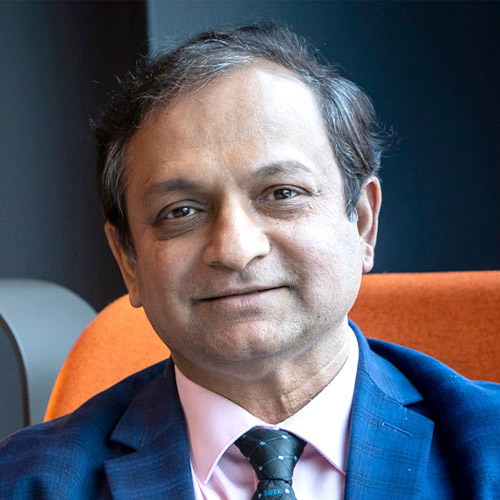
Ashutosh brings in a unique blend of industry and academic experience. He is currently Chief 5G Strategist at The Johns Hopkins University Applied Physics Labs and serves as associate research professor and the director of Doctor of Engineering program at Johns Hopkins University in addition to his teaching. His past career spanning more than 30 years, includes Director of Technology Security and Lead Member of Technical Staff at AT&T, CTO of cybersecurity company NIKSUN, Senior Scientist in Telcordia Research, Director of Central Research Facility at Columbia University, and Computer Engineer with TATA Motors. Ashutosh has published more than 110 papers, IEEE-Wiley book on Handoff Optimization, 6 book chapters and has 31 issued patents. As a Technical Leader in 5G, Ashutosh has served as the founding Co-Chair for the IEEE Future Networks (https://futurenetworks.ieee.org/), IEEE Connecting The Unconnected (ctu.ieee.org) and IEEE 5G/6G Innovation Testbed (testbed.ieee.org). Ashutosh is a Distinguished Alumnus of NIT Rourkela with BS in Electrical Engineering, MS in Computer Science from NJIT, and Ph.D. in Electrical Engineering from Columbia University under the supervision of Prof. Henning Schulzrinne. Ashutosh is a Fellow of IEEE, Distinguished member of ACM, Fellow of AAIA, and Member of National Academy of Artificial Intelligence.
Cellular networks have evolved since 1980. Today, cellular networks connect over half the world’s population only. Since introduction in 1995, Wi-Fi (IEEE 802.11) networks have become very popular as they use unlicensed bands but they are not widely deployed and have low coverage. LEO satellites (e.g., Starlink, Kuiper) are being deployed to augment the existing GEO and MEO-based non-terrestrial infrastructure to provide wider coverage even and higher bandwidth. However, the end devices are not well equipped to connect to satellite networks and there are handover issues. Hence, there is a lack of ubiquitous connectivity, interoperability, and co-existence. Converged Networks play an important role in providing secured and seamless connectivity to the end users as they move around various access networks, lose connectivity to the existing network and connect to new networks. Converged networks provide desired quality of service to the first responder community and mission critical users as they make transition from one network to another network. However, there are various challenges with deployment of converged networks, namely interference management, complex network management, seamless handover, resource allocation, extended threat landscape, quality of service management, virtualization and slicing management among others. Converged networks are different than traditional networks in terms of performance metrics, topology, mobility, backhaul, down link vs. uplink data rate. IEEE 802.21 and 3GPP ATSSS have defined standards to address some of these issues. While each of the access technologies is making progress in its vertical domain, there is a need to solve the interoperability and co-existence issues before ubiquitous connectivity becomes a reality.
This workshop will discuss some of the opportunities and challenges associated with converged networks based on the current state of deployment and will look into some of the use cases where converged networks can be most useful.

Title: Storage and Memory in Space Communications
Tom Coughlin, President, Coughlin Associates is a digital storage analyst and business/ technology consultant. He has over 40 years in the data storage industry with engineering and senior management positions. Coughlin Associates consults, publishes books and market and technology reports and puts on digital storage and memory-oriented events. He is a regular contributor for forbes.com and M&E organization websites. He is an IEEE Fellow, 2024 IEEE President, Past-President IEEE-USA, Past Director IEEE Region 6 and Past Chair Santa Clara Valley IEEE Section, and is also active with SNIA, SMPTE and CNSV. For more information on Tom Coughlin go to www.tomcoughlin.com.

Title: Exploring Non-Terrestrial and Terrestrial Solutions to enable Ubiquitous Connectivity
Dilip Krishnaswamy has led the architecture, design, and development of engineering platforms & products at Intel Corp, Qualcomm Research, IBM Research, and Jio Platforms. He received his PhD degree in Electrical Engineering from the University of Illinois at Urbana-Champaign. He is an alumnus of IIT Madras where he received a B.Tech. degree in Electronics and Communication Engineering. He is an inventor on 80+ granted patents and has authored 80+ research publications. He is presently serving as Executive Vice-President at C-DOT (Centre for Development of Telematics), Bangalore, India, where he is leading Advanced-5G Engineering and 6G Innovation efforts.

Title: LAP-Based Aerial Cells: Building Blocks for Converged Networks
Tushar Vrind is a Senior Technical Director at Samsung Semiconductor India R&D (SSIR), where he leads the Feature development work portfolio in the Modem Software Development Group. In addition, he also leads strategic initiatives of architecture, product, and technology differentiation in the System LSI (SLSI) System on Chip (SoC) Lab. With over 25 years of professional experience in wireless communication, ranging from 2G to 5G, and a specialization in embedded domain, Tushar has played a crucial role in the development of the Exynos System on Chip (SoC) at Samsung Semiconductor.
Throughout his career, Tushar has secured over 50 applied patents and 30 plus granted patents worldwide in the areas of embedded systems and wireless protocols. His expertise has been widely recognized, and he has co-authored over 40 technical contributions, papers, and journals with 3GPP and IEEE. He is also a Senior Member of IEEE, and member IEEE ComSoC. Tushar holds a bachelor’s degree in computer engineering from Birla Institute of Technology, Mesra, India, Master of Science (Research) and PhD in Wireless Communication and Networks from the International Institute of Information Technology (IIIT), Bangalore, India. He also participated in Stanford Ignite, a certification in Entrepreneurship and Innovation from the Graduate School of Business, Stanford University.

Title: AI-Powered Intelligent Networks for Beyond-5G/6G: Bridging Terrestrial and Non-Terrestrial Domains
Gnanapriya Chidambaranthan is an Associate Vice President, Unit Technology Officer, Communications, Media, HiTech (CMT) Industry vertical in Infosys. She has 33+ years of experience in Telecom & IT and contributes to CMT unit strategy, drives technology adoption for business solutions across varied programs globally.
She leads AI strategy, Agentic AI, AI Native Telco, AI led Modernization, Digital Transformation, Enterprise Architecture, 5G, B5G / Edge, 5G Use Cases & Industry solutions, Blockchain solutions & Software Marketplaces, Data Modernization, Industry Innovations, guiding varied transformation & modernization programs.
As part of 5G / 6G Eco System integration, her focus areas include, 5G Network slicing, 5G, B5G & Edge vertical industry use cases, Telco / Network Cloud automation, Telco Marketplace. She focuses on powering digital transformation leveraging 5G, Edge, AI / ML, IoT and emerging technologies. She has contributed to India 6G vision paper.
She holds Bachelor’s Degree in Electronics & Communication Engineering, Master’s degree specializing in Communications Engineering, Business Administration.
Under her guidance & drive, Infosys has won 19 Outstanding Catalyst Team Awards in TM Forum, she received Individual Recognition Award @ Industry TM Forum, serving as TMForum Technology Advisory Committee. She had contributed to TMForum OpenAPIs, ODA, 5G, B5G, Edge, Software Marketplaces, Blockchain, technology reports, reference architectures.
She is a speaker in multiple Industry and Technology Forums. She received ‘Best Technical Presentation’ award in SPE. She is a Senior IEEE member, IEEE ComSoc Bangalore Chapter Vice Chair, IEEE WIE member, IETE Fellow, The Institution of Engineers (India) Fellow, Governing Board of LF Networking (2023 – 24). She has co-authored book on Digital Signal Processing I, II editions published by McGraw Hill, International edition and translated to Mandarin.

Contact:
Mohit Kumar
M: +91 74286 93369
E: mohit@cimglobal.net
ieeespace2027@gmail.com