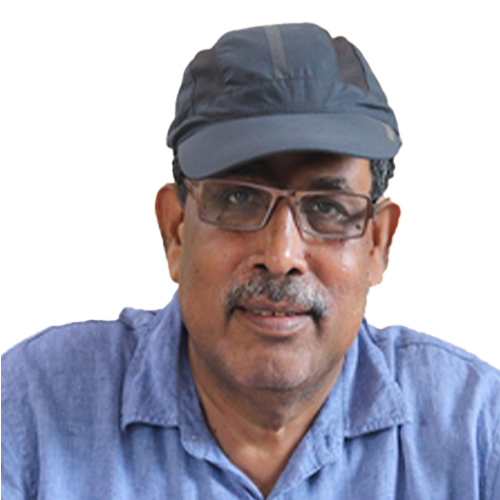
Mr Tapan Misra started his career in Space Applications Centre, ISRO in 1984 and since then played a pivotal role in growth of Microwave Remote Sensing payloads and allied technologies in SAC and in India.
He is widely known for the design and development of C-band Synthetic Aperture Radar (SAR) of the RISAT-1 in 2012. He steered the development of RISAT-2 series of high resolution X-band SAR systems. He conceptualised and led
development of highly miniaturised Dual Frequency (L and S band) SAR (DFSAR) for Chandrayaan 2 orbiter (2019). He was also the principal designer of Ka band radio altimeter which enabled smooth landing of RLV and Chandrayaan 3 lander. He is also the principal architect of the novel sweepSAR of NISAR (NASAISRO SAR), launched in 2025.
He was a key contributor for system engineering of Multi-frequency Scanning Microwave Radiometer (MSMR) payload for Oceansat-1 during 1995-1999 and Scanning Scatterometer of Oceansat-2 in 2009. He was appointed as Director of Space Applications Centre (SAC) in February 2015. For a brief period he had additional charge of Director, Physical Research Laboratory, Ahmedabad from June 2016 to February 2017.He also headed the Office of Innovations Management, ISRO, Bangalore. Tapan Misra was appointed as a Senior Adviser to Chairman of ISRO in July 2018.He superannuated from ISRO in January 2021.
Presently he is holding the position of Founding Director and Consultant Chief
Scientist of a deep tech startup, named SISIR Radar Pvt Ltd, based out of Kolkata. Under his leadership, SISIR Radar has emerged as one of the very few key Deep Tech start ups in India, specializing in developing miniature SAR System, ultra wide band GPR systems and innovative Spaceborne SAR. Presently Sisir Radar manufactures and sells world’s highest resolution foliage penetration SAR on drone borne platforms. Sisir Radar is going to launch the first of its L band SAR constellation by 2027.
He received Vikram Sarabhai Research Award in 2004 and ISRO Merit award in
2008 for his contribution to the development of SAR technology. He was elected as Fellow of Indian National Academy of Engineering in 2007. He was elected Corresponding Member of International Academy of Astronautics in 2008.
He is also elected Fellow of IETE and ISRS. He was awarded DSc (Hon.) in 2016 and Distinguished Alumnus award in 2017 by his Alma Mater, Jadavpur University. He chaired CGMS 2018 (Coordination Group for Meteorological Satellites) in Bangalore, represented India as Principal to CEOS (Committee on Earth Observation Satellites) in Paris in 2017 and participated as team member of Indo-US Strategic Dialogue on Space Cooperation in Washington DC in 2016 and 2018. He also taught at IIT Kharagpur and IIT Jodhpur as Adjunct Professor.
He holds eight granted patents. He has five copyrights and more than fifty five papers to his credit.